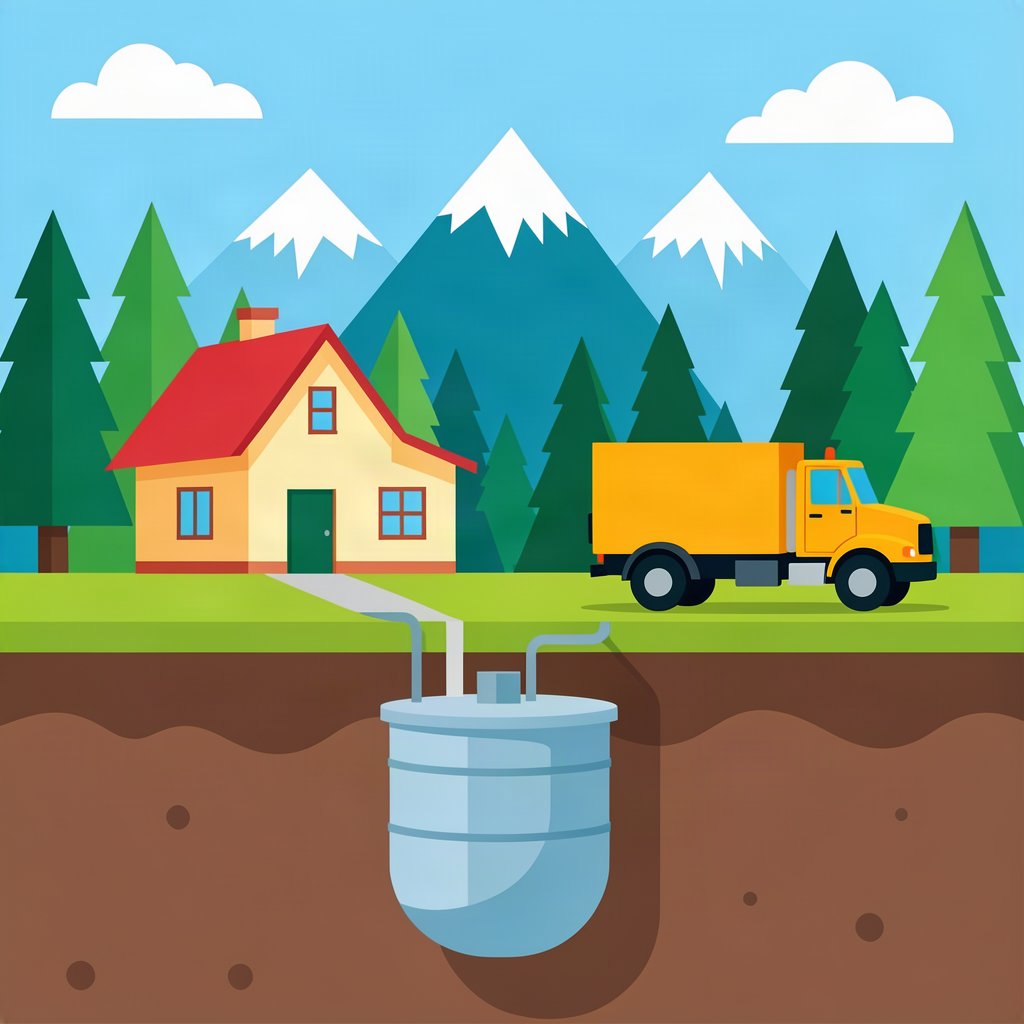
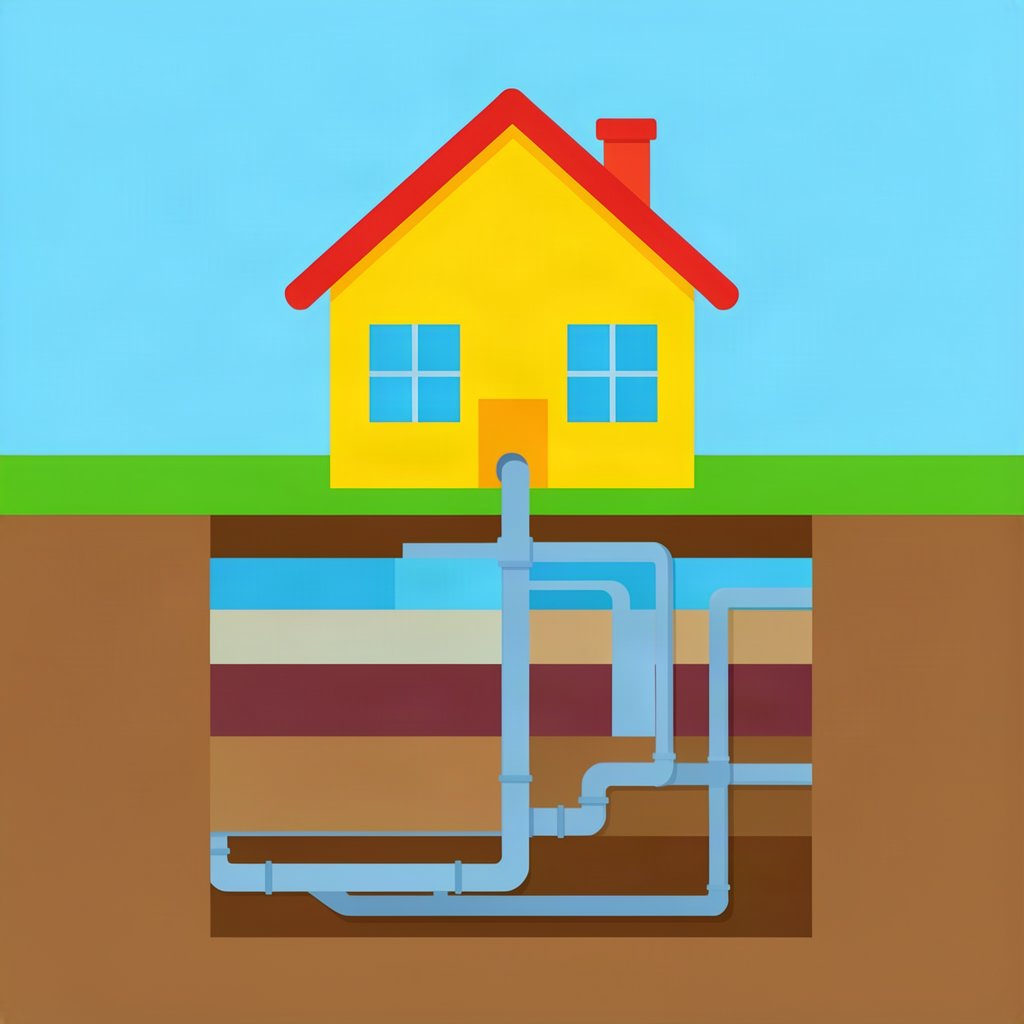
For most of septic history, the drainfield recipe was simple: dig a trench, fill it with gravel, lay in perforated pipe, and bury it. Gravel was cheap and it worked — until someone asked what the gravel was doing to the soil underneath it. The answer, laid out in the design deck behind this guide, has quietly changed how modern leach fields are built.
The insight is called the soil compaction problem, and it reframes the drainfield from a plumbing detail into a soil-preservation exercise.
The insight: installation weight destroys soil structure
Native soil treats wastewater through its structure. Between soil particles run macro-pores — tiny continuous channels that carry oxygen downward and let treated water move away. Those pores are the system's lungs and drainage network, and they are fragile. When heavy equipment and loaded gravel trucks roll across a trench site, and when yards of washed rock are dumped and compacted into the trench, the weight crushes the pore structure at the very interface where treatment happens.
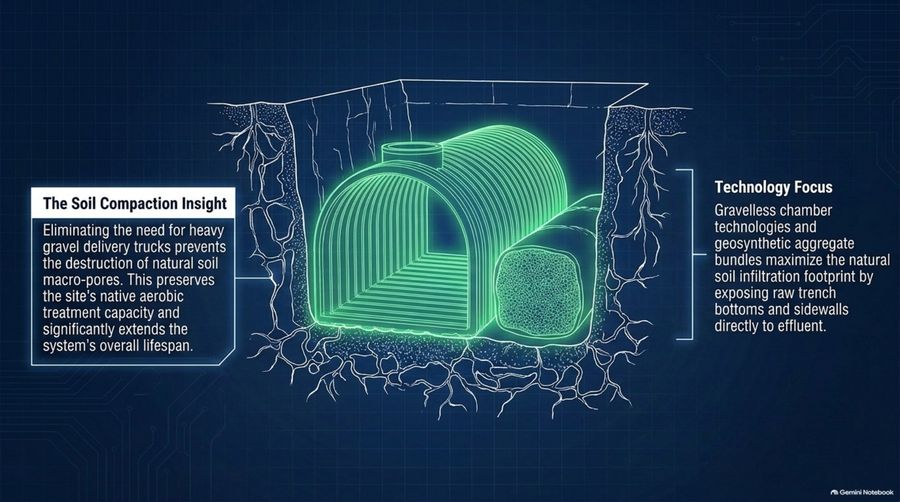
The deck states the consequence without sugarcoating: eliminating the need for heavy gravel delivery trucks prevents the destruction of natural soil macro-pores. No trucks, no dumped rock, no compaction — the soil keeps the structure it evolved to have.
Why macro-pores matter for treatment
Soil is not a passive filter; it is a living biological reactor. Aerobic bacteria colonize the soil at the trench interface and digest the organic load in effluent as it passes. That biology needs oxygen, and oxygen travels through the same macro-pores that carry water. Crush the pores and you get saturated, oxygen-starved soil, a mat of undigested biomat at the interface, and a field that ponds instead of treating.
Preserving macro-pores preserves what the deck calls the site's native aerobic treatment capacity — the free treatment capacity the soil already had before construction began.
Effluent moves through healthy soil as a thin film clinging to particle surfaces, where oxygen is available and aerobic bacteria are active. When compaction removes the pore space, flow turns saturated and channelized — water finds the few remaining paths, contact time collapses, and treatment drops to a fraction of what the soil could deliver. That is why the deck treats installation weight as a treatment variable, not a construction convenience.
Chambers and geosynthetic bundles change the interface
Gravelless chamber technology replaces the gravel envelope with an engineered structure: open-bottom chambers or bundled geosynthetic aggregate that support the soil above while leaving the trench surfaces exposed. The deck's language is precise — these technologies maximize the natural soil infiltration footprint by exposing raw trench bottoms and sidewalls directly to effluent.
That exposure matters in two ways. First, more soil surface participates in treatment: not just a narrow band under the pipe but the full bottom and sidewall area of the trench. Second, effluent meets undisturbed native soil rather than a layer of imported rock, so the soil's own structure and biology do the work they evolved to do. The deck's bottom line: this approach significantly extends the system's overall lifespan.
What this means for Flathead County soils
Soils around Kalispell vary widely — sandy glacial outwash in some neighborhoods, silty lake-plain soils closer to the valley floor, rocky fills elsewhere. Where soils are workable but marginal, every square foot of functioning infiltration surface and every preserved macro-pore counts. A chamber field that protects soil structure can keep performing on sites where a gravel field would gradually clog at the interface.
There is a practical side too. Chamber systems arrive on pallets, not dump trucks. Lighter installation equipment, no gravel stockpiles, and narrower disturbance zones mean less site damage during construction — which matters on finished lots where the drainfield area doubles as the backyard.
The same logic applies to replacement fields. When an old drainfield fails, the instinct is to dig out the gravel and rebuild in place — but re-excavation re-compacts soil that has already been worked once. On many Flathead lots, a chamber system sited in fresher soil, or a design that reuses the trench with minimal disturbance, preserves what little virgin structure remains and gives the second field a realistic service life.
Is gravelless right for your site?
Chambers are not a magic wand — they still require suitable soil, proper depth, and correct spacing, and the site evaluation and local code decide what can be built where. They also perform best as part of a complete design: uniform dosing, adequate separation to groundwater, and spacing that lets each trench rest between doses. Chambers do not replace good hydraulics — they protect the soil those hydraulics depend on, and for the right site that protection is what gives the system its long service life.
If you are replacing a failing drainfield or building a new system in the Kalispell area, ask your installer whether gravelless chambers or geosynthetic aggregate suit your soil test results. We can match you with pre-vetted, licensed septic professionals across Flathead County who install and design modern leach fields. Call (406) 313-3856 or request free quotes through our online form — no obligation.
Frequently Asked Questions About Gravelless Chamber Leach Fields
What exactly is a gravelless chamber?
It is an open-bottom, arched structure installed in the trench in place of gravel. Effluent is distributed inside the chamber and infiltrates through the raw trench bottom and sidewalls directly into native soil, while the chamber supports the backfill above.
Why is gravel bad for soil in a drainfield?
Gravel itself is not toxic — the problem is construction weight and the interface it creates. Gravel trucks and dumped rock compact the soil and crush macro-pores, and the gravel layer blocks effluent from contacting the full trench surface. Preserving pore structure keeps the soil's native aerobic treatment capacity intact.
Can chamber systems handle clay soils or high water tables?
That depends entirely on the site. Chambers still require soil with adequate percolation and separation to groundwater; they do not bypass the soil's limitations. A proper site evaluation and soil test, reviewed against local code, determine whether any drainfield — gravelless or not — is feasible on your lot.