The $30,000 Dilemma: When a Health Department Mandates an Expensive Upgrade
Blog · Financial guide · Homeowners
It starts with a letter: your drainfield is failing and the health department requires action. Then the bids arrive, and the contractor everyone recommends quotes $25,000 to $30,000 for an aerobic treatment unit or a mound. But the most expensive option is not always the one you are legally required to build, and it is rarely the one that makes financial sense over 20 years.
The letter from the health department
Health department letters rarely use the word "may." They describe sewage surfacing in the yard, a failed dye test, or a neighbor's complaint, and they cite the regulation requiring the system to be brought into compliance. Read that letter twice before calling any contractor: it documents a failure of the existing system, and it states a standard the replacement must meet. Those are not the same thing, and conflating them is how homeowners end up paying for an upgrade they were never required to buy.
Often the real problem is a drainfield at the end of its service life, clogged by years of accumulated biomat or undersized for the household. That is a repair problem, not necessarily a technology problem. Ask the permitting office, in writing, which system types your site is approved for before any money moves.
The three pathways, with real numbers
Once you know what is required, a failing conventional system usually leaves three options. The figures below are real planning numbers, compared over a full 20-year horizon at a 6% discount rate:
- Repair-As-Is (gravity replacement): about $6,500 upfront. Verify a watertight tank, replace damaged concrete tees with durable plastic fittings, and install a new gravity drainfield matching or slightly exceeding the original footprint. About $50/year ongoing; roughly a 15-year service life.
- Bio-remediation: about $3,500 upfront. Aerobic microbial dosing plus pulsation (systems such as SludgeHammer) digests clogging biomat and restores soil permeability, often with no excavation. About $150/year for dosing and pump checks; a 10-year treatment cycle.
- High-tech ATU or mound: about $25,000 upfront, with real operating costs near $650/year for power, parts, and service. Blowers, pumps, and electrical service add up; this is the option that lands in the $30,000 range.
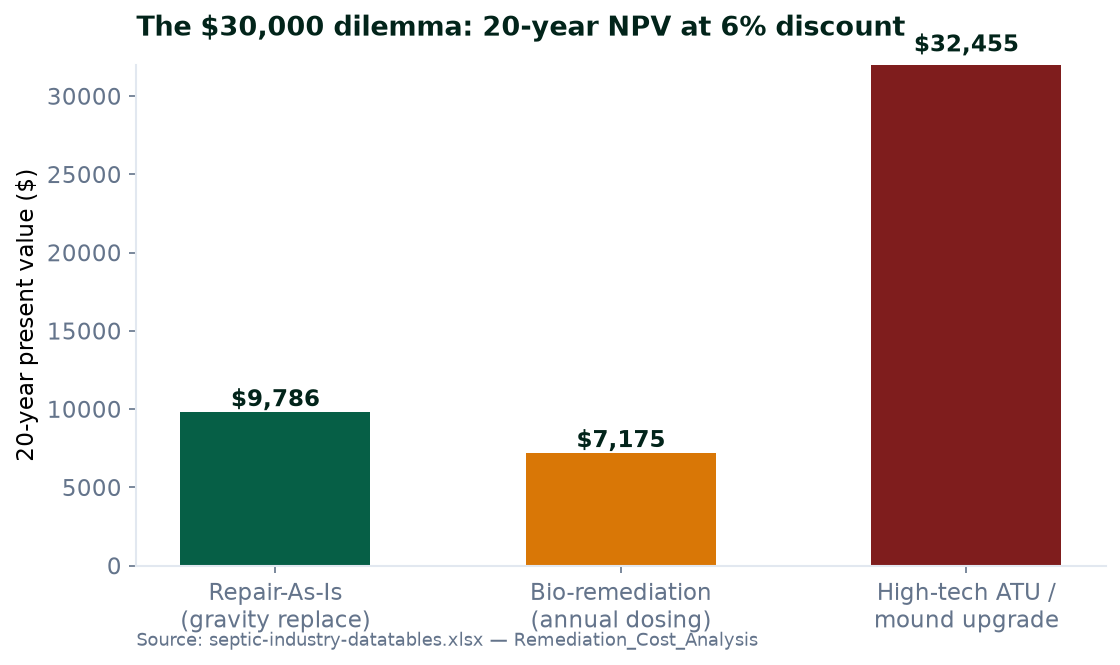
The spread is striking. The ATU/mound route carries a 20-year net present value of roughly $32,500, about three and a half times the repair path at roughly $9,800 and more than four times bio-remediation at roughly $7,200 — and it costs more every single year. If your letter requires no nutrient reduction, paying for it is like buying a ski boat to cross the Flathead River.
When the ATU is genuinely required
ATUs and mounds are an engineering answer to genuine site conditions, not a conspiracy. Two standards tell you when a mandate is real:
- NSF/ANSI Standard 245: the aerobic-unit certification requiring at least 50% total nitrogen reduction, the threshold that appears in nitrogen-limited watersheds where a conventional drainfield will not pass muster.
- CAN/BNQ 3680-600 Class III: the cold-climate certification for severe climates like ours, requiring effluent at or below 15 mg/L CBOD5 and 15 mg/L TSS.
In a nitrogen-sensitive drainage or lake protection zone, an approved alternative system may be non-negotiable. But "the soil is too wet for a drainfield" and "this lot is in a nitrogen-limited watershed" are different problems with different paperwork; only the second one puts you in ATU territory.
Download the engineering deck (PDF)
Get the regulatory pathway in writing
The single most valuable step in this process costs nothing: get the regulatory pathway confirmed in writing by the office that issued the letter. Ask the sanitarian to state, on letterhead or in an email you keep, which system types are approvable for your site and which standards the replacement must meet. If the answer is "any approved system that stops the failure," you have just escaped the $30,000 quote; if it is "NSF 245 or equivalent," the ATU conversation is real and you can budget accordingly.
A written pathway also protects you at inspection. Permits are issued against documented designs, and a contractor's verbal assurance of "what the county will accept" is worthless when the inspector arrives. If a contractor refuses to put the pathway in writing or pushes you to start before the permit clears, get a second opinion rather than writing a deposit check.
Questions to ask before you choose
- What exactly is failing, and how do you know? A tank inspection and drainfield evaluation should precede any quote; a contractor who bids $25,000 without opening the tank is guessing.
- What does the health department require, in writing? Ask to see the cited standard, then verify it independently with the permitting office.
- Is bio-remediation permitted here? If the failure is biomat clogging, microbial remediation can restore the field for a fraction of replacement cost.
- What are the true annual costs of the ATU? Power, service contracts, and parts add up; the $650/year figure is realistic and recurs for 20 years.
- What happens if the approved design fails inspection? A written warranty and a redo clause in the contract matter more than the brochure.
The Flathead Lake factor
Location matters enormously, and few places illustrate it like the country around Flathead Lake. The largest natural freshwater lake west of the Mississippi sits in a watershed Montana regulators treat with real care, which is why alternative systems are commonly required near its shoreline and along sensitive drainages. On a lakeshore bench or in shallow, high-groundwater soils, expect nutrient limits a gravity system cannot meet — and expect "NSF 245" in your letter.
That is a reason to verify which zone your property is actually in, not to panic. Lakeshore lots inside protection zones get the full alternative-system treatment, while properties a few hundred yards back with deep, well-drained soil often stay on conventional repair. Cold winters add another wrinkle: a repair designed for a warm-weather state will not pass local review. An independent local expert who has worked around Flathead County for years can tell you within an hour whether you face the $7,000 conversation or the $30,000 one.
Talk it through before you sign anything
A health department letter is not an invoice. Kalispell Septic is an independent matching service, not a provider, so the help we arrange fits your situation rather than a sales quota. Call (406) 313-3856 or request your free matches here for up to three pre-vetted local professionals within one business day — including a second opinion on whether the $30,000 system is truly the only way forward.