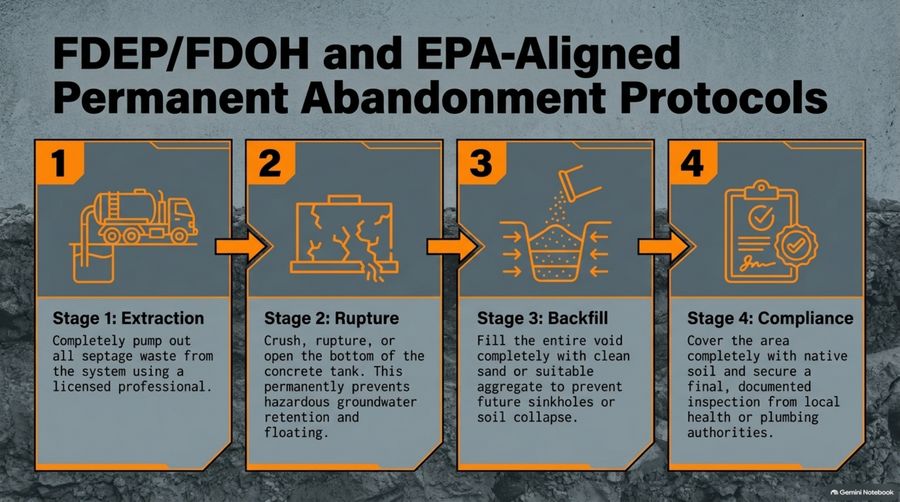
Sooner or later, every septic system retires. The house connects to a sewer line, a failed system is replaced by something new, or a property is subdivided and the old tank no longer serves anyone. What happens to the abandoned tank matters — and the technical deck behind this article, Septic System Failures: Advanced Remediation, Pipe Clearing, and Regulatory Siting (generated with Gemini Notebook), closes with a four-stage protocol for doing it permanently and legally. The deck's version is built on FDEP/FDOH and EPA-aligned practice from Florida; the stages translate directly to Montana, where the state DEQ and county sanitarians administer the rules. Here is how abandonment is supposed to work, stage by stage, and why cutting corners creates problems that outlive the tank.
Stage 1: Extraction by a Licensed Professional
The first stage is complete removal of all septage: the tank is completely pumped out by a licensed professional, including the sludge and scum that ordinary pumping sometimes leaves behind, and the waste is hauled to an approved disposal site. This is not the moment to bargain-shop. Septage is regulated waste in Montana, and a licensed pumper carries the permits, insurance, and disposal records that keep it out of ditches and drainage ways. Extraction is also when the tank gets its first honest look in decades — the pro can confirm what material the tank is, whether it is intact, and what Stage 2 will require. Anyone who suggests skipping the pump and just knocking the lid in is about to bury a tank full of sewage, and the groundwater downslope will eventually file the complaint.
Why is extraction non-negotiable? A tank abandoned with contents intact becomes a slow-release capsule: rainwater infiltrates, the tank overflows through whatever opening exists, and concentrated waste migrates into the soil and groundwater for years. Emptying the tank first removes the pollution source so the rest of the protocol can make the void safe.
Stage 2: Rupture — Preventing the Sinkhole and the Float
With the tank empty, the second stage is to crush, rupture, or open the bottom of the tank. That sounds destructive because it is meant to be. An intact hollow tank buried in wet ground does two bad things. First, it becomes a cistern: groundwater seeps in, and the void collects water that has nowhere to go — a buried swimming pool that never drains. Second, an empty tank in a high water table can literally float upward out of the ground, heaving soil, pipes, and anything built on top. Rupturing the bottom permanently prevents hazardous groundwater retention and floating by making the tank incapable of holding water. Concrete tanks are typically broken in place; steel tanks may be collapsed or have their tops and bottoms opened; the goal is the same — no watertight void may remain.
Stage 3: Backfill With Clean Material
The third stage fills the entire void completely with clean sand or suitable aggregate. Backfill is what prevents the surface collapse that abandoned tanks are famous for. A tank that is ruptured but not filled leaves a cavity; decades later, when the lid rots or the walls give way, the ground above drops into it — the classic mystery sinkhole in an old yard. Clean sand or aggregate is specified because it drains, compacts predictably, and will not settle into voids the way dumped topsoil does. The fill should be placed in lifts and compacted as the void is filled, right up to the top of the tank, so there is no air space left to collapse.
Drainfield piping associated with the abandoned system gets the same treatment: lines are cleared or collapsed and filled so no open conduit remains to channel water under the yard. An abandoned system should be as inert underground as a buried boulder — nothing hollow, nothing that holds water, nothing that can settle.
Stage 4: Cover and Final Documented Inspection
The final stage is compliance: cover the area completely with native soil, restore the grade, and secure a final, documented inspection from the local authorities. In the deck's home state that means FDEP or the county health department; in Montana the analog is the DEQ and your local county sanitarian — in Kalispell, typically Flathead County environmental health staff. The inspector verifies that the tank was pumped, breached, and backfilled properly, and the closing record becomes part of the property file. That piece of paper matters more than homeowners expect: when the property sells, when a new system is permitted on the same lot, or when a neighbor's well test comes up odd, the documented abandonment is the proof that your old tank is not the problem.
Because Montana's specific forms, fees, and approval paths vary by county and by whether the system served a single home or something larger, treat the stages above as the framework — and verify the paperwork details with your local inspector before you schedule the work. The deck's FDEP-style language generalizes cleanly; the signatures required are local. That final documented inspection is not bureaucracy for its own sake — it is the difference between retiring a system and burying a liability.
Abandonment is a four-stage job with zero room for shortcuts, which is why every stage involves licensed or inspected work. Call (406) 313-3856 or get matched with licensed Kalispell septic pumpers and contractors who handle abandonments start to finish. If you are deciding whether to abandon or rehabilitate an old system, our why-hire-a-pro guide and Kalispell septic guide are good next reads.
Frequently Asked Questions
Why can't I just leave an unused septic tank in the ground?
An intact, empty tank in wet ground can float, collect groundwater, or collapse decades later into a sinkhole — and a tank left full of septage leaks waste into the soil for years. Abandonment rules exist because buried watertight voids and buried waste both fail eventually, usually at the worst possible time.
Does the septic tank need to be removed entirely instead of abandoned in place?
In most Montana jurisdictions, proper abandonment in place — pump, rupture, backfill, inspect — is acceptable and is usually easier than full excavation, which can damage yards and require heavy equipment access. Your local sanitarian will confirm which option the county requires for your tank type and location.
Who performs the final inspection, and why do I need documentation?
In the Kalispell area, the final inspection is typically arranged through Flathead County environmental health under Montana DEQ guidance, following the same family of protocol the deck attributes to FDEP and EPA. The documentation protects you at property transfer and proves the old system is not a source of contamination or collapse.
Retiring an old septic system? Call (406) 313-3856 or get matched with local licensed septic professionals who will walk the four stages with you — free quotes, no obligation.