Advanced Biomat Remediation: Restoring Clogged Drainfields Without Excavation
Blog · Technical guide · Engineers & installers
A failing drainfield is usually an interface failure, not a pipe or soil failure. Organic solids leaving the tank accumulate at the soil interface beneath the trench and consolidate into a low-permeability mat that chokes infiltration. The classic remedy, excavate and replace the field, treats a biological problem with a mechanical solution; advanced aerobic microbial remediation digests the mat in place and restores hydraulic capacity, with no excavation.
The biomat mechanism
Every soil-based system builds a biomat: an organic layer of trapped solids, microbial biomass, and extracellular polymers at the gravel-soil interface and trench sidewall. Properly loaded, the mat is self-limiting and the field runs for decades. Trouble starts when loading outpaces the soil's capacity to process it — an undersized field, an overgrown household, or a neglected tank pushing solids into the trenches. The mat thickens, conductivity collapses, and the field ponds, surfaces, or backs up.
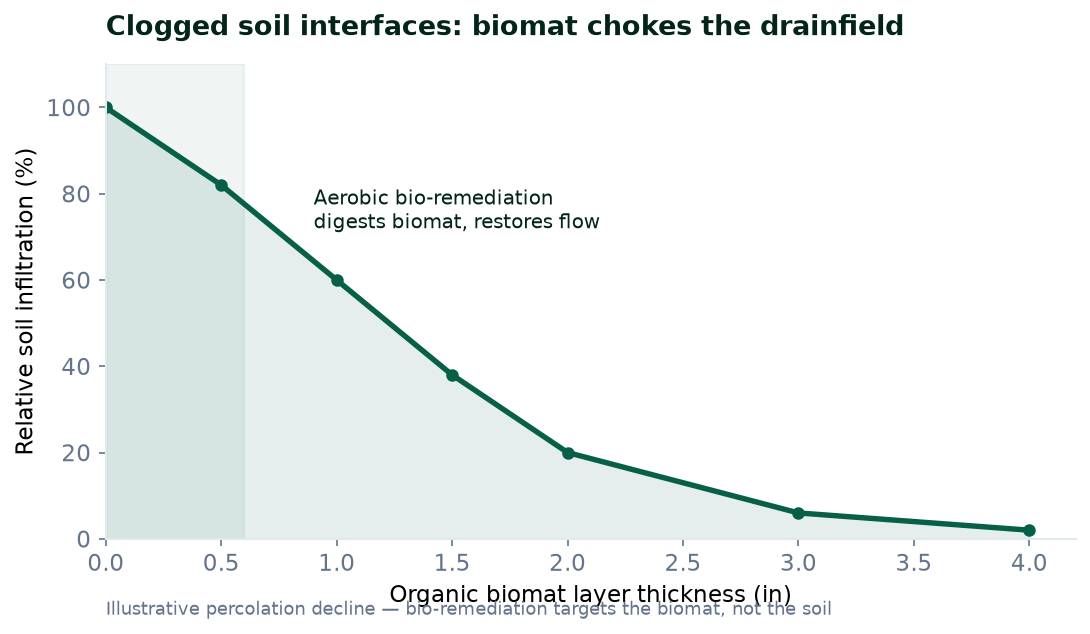
The relationship is sharply nonlinear: at roughly an inch of mat the interface has lost about 40% of its relative infiltration; at two inches, about 80%; beyond three inches it is effectively sealed. Hence a field that served a household for fifteen years can fail within a single season.
The diagnostic tree: classify before you treat
Start with one question: where is the blockage, and is it physical or biological? Analyze sink and toilet flow. A singular sluggish drain — one fixture backing up while the rest drains normally — is a household plumbing blockage, not a field failure. Branching or system-wide sluggishness moves the investigation to the tank interface, which must be opened and inspected.
At the tank, read the water level. A flooded tank, effluent at or above the outlet invert, means the downstream path is not accepting flow: suspect the outlet tee, the tightline, or the drainfield. An unflooded tank with clear effluent points upstream, between house and tank. Watch for the "never pumped" fallacy: neglected tanks accumulate sludge until effective capacity shrinks, and once sludge reaches the outlet pipe, solids migrate into the drainfield and permanently plug the lines. Sludge visible at the outlet means the field is already biologically loaded.
Classify the blockage as upstream (house to tank, or the inlet) or downstream (outlet tee, tightline, or drainfield). For tightline blockages, excavate and check for settling breaks, shear points, or root intrusion; a crushed or root-filled line defeats any biological treatment upstream of it. Only with piping intact and the failure in the soil interface does the tree reach its fork: mechanical clearing, root mitigation, or biomat treatment.
Mechanical clearing vs. root mitigation vs. biomat treatment
- Mechanical clearing, for localized hard blockages: the right tool when the obstruction is physical and confined, typically in 1- to 10-inch pipes. Mechanical augers (Roto-Rooter-style equipment) or water-expanding pulsators such as the Drain King break up grease, scale, and debris — effective on the pipe, wrong for a soil interface problem.
- Root mitigation, for invasive root intrusion: when excavation reveals roots in the tightline or distribution lines, pair mechanical clearing with a plumber's snake, then remove the tree or install a root barrier. Treating roots with biology is a category error; treating biomat with a snake is an equally expensive one.
- Biomat treatment, for accumulated organic solids in the soil: when piping is intact and the diagnosis is a thickened mat at the soil interface, deploy advanced aerobic microbial bio-remediation — dosing systems such as SludgeHammer that digest the accumulated solids and restore soil permeability in place.
The copper sulfate hazard
The classic shortcut is copper sulfate ("bluestone") root killer poured down the drain. It kills roots, but the collateral damage is severe: bluestone destroys the beneficial bacterial cultures in the tank that perform primary treatment, so the tank exports solids to the very field you are trying to save. Copper is a persistent heavy metal that can migrate toward the water table; around Kalispell's gravelly, high-infiltration soils the groundwater risk is real. Root intrusion is a mechanical problem with mechanical solutions — a snake, excavation, root barriers. There is no responsible chemical substitute.
How aerobic microbial dosing works
Aerobic microbial bio-remediation treats the drainfield as a biological system, not a passive sand filter. The dosing products, of which SludgeHammer is the best-documented example, introduce facultative, aerobic-preferring bacteria that colonize the soil interface and metabolize the biomat. As the organic layer is consumed, macro-pores reopen, the interface regains hydraulic conductivity, and effluent resumes percolating into the native profile.
Three properties distinguish the approach. It is in situ: biology travels through the existing distribution system, with no excavation and no abandonment of the field. It is non-destructive: digestion removes only the organic obstruction, leaving the mineral fabric intact. And the system keeps operating during treatment, unlike a replacement project. Restoration times vary with mat thickness, soil temperature, and loading; cold Montana winters slow biological activity, so schedule for the warmer season.
Download the engineering deck (PDF)
When biomat treatment is not the answer
Some failure modes dosing cannot fix. Structural failure first: a cracked tank, crushed tightline, settling breaks, shear-point damage — any loss of containment or conveyance must be repaired mechanically before biology can help. Regulation second: where the authority mandates an alternative treatment unit — NSF/ANSI 245 with at least 50% total nitrogen reduction, or CAN/BNQ 3680-600 Class III limits of 15 mg/L CBOD5 and 15 mg/L TSS — no drainfield restoration satisfies the nutrient standard. Those sites, common near Flathead Lake and other sensitive shorelines, need the engineered unit regardless of soil health. And biomat remediation presumes adequate soil: poor native soil, seasonal high groundwater, or an undersized field may recover hydraulically yet still fail its loading test.
Repair-As-Is mechanics
When the diagnosis lands on repair, the Repair-As-Is protocol is the reference standard. Verify watertight tank integrity first; a leaking tank contaminates the soil a new field depends on. Replace damaged concrete tees with durable plastic fittings. Install a gravity replacement drainfield, or a shallow pressure-dosed field where conditions require it, matching or slightly exceeding the original footprint. For pressure-dosed designs, the freeboard check is critical: dosing volume must account for inflow during the dose cycle, the dose volume, and return flow before pump cutoff, expressed as [Qinf + Qdose − Qeff] × T — net fill rate times run time must fit the available freeboard, or the pump short-cycles and drowns. Permanent abandonment follows four stages: licensed septage extraction, rupture of the tank bottom to prevent floating, backfill with clean sand or aggregate, and a documented compliance inspection.
Get a matched second opinion on the diagnosis
A remediation or replacement decision deserves an independent read. Kalispell Septic is an independent matching service, not a provider, connecting homeowners with pre-vetted local professionals. Call (406) 313-3856 or request your free matches here for up to three qualified pros within one business day, no obligation.