Forensic Septic Inspections: Core Samplers, Structural Checks, and the 10/20 Rule
Blog · Professional guide · Inspectors, pumpers & health operators
A professional septic inspection is a forensic exercise: its purpose is to document what is actually happening inside the tank and its laterals before it becomes a property-transfer dispute, a permit denial, or a drainfield failure. In Flathead County — where home sales, building permits, and health-department actions routinely hinge on inspection reports — the difference between a “looked fine to me” opinion and a defensible, evidence-based finding is the difference between following a protocol and winging it.
Why visual inspection is not enough
A flashlight through the access port shows the surface of the scum layer and almost nothing else. The tank’s working volume — and nearly all of its stored solids — sits below the waterline, invisible from above. Clear-looking effluent at the surface can hide two feet of compacted sludge at the bottom, and the “never pumped” systems that look healthiest from the lid are often the closest to catastrophic failure: sludge has quietly lowered the effective retention volume until raw solids are one laundry day away from the outlet baffle.
The failure pathway is irreversible. Once sludge escapes the outlet tee it travels to the drainfield, where it seals soil pores and feeds the biomat — the $300 service call becomes a $15,000 drainfield replacement that no amount of pumping can reverse. An inspection that does not quantify the layers cannot trigger the pumping decision at the right moment, and your name is on the report. The tool that closes the gap is the core sampler.
The Sludge Judge method
The Sludge Judge — a one-inch clear plastic core sampler — remains the single most informative instrument in the field. The protocol is straightforward but unforgiving of shortcuts:
- Stage the sample points: take cores at three positions — inlet end, middle, outlet end — because solids distribution is never uniform, and the outlet end is the one that matters most.
- Lower, do not drop: ease the tube slowly through the scum layer to the tank floor. A fast drop churns the layers and destroys the profile you are trying to capture.
- Seal and withdraw: cap the top of the tube with your thumb to trap the column, then lift smoothly so the clear tube preserves the stratification.
- Measure and record: read the floating scum thickness at the top of the column and the settled sludge height at the bottom, with the clear effluent zone between. Record the inches on the report — and photograph the column for the file.
- Decontaminate between tanks: rinse and sanitize the sampler before the next site so you never carry biology — or evidence — from one system to another.
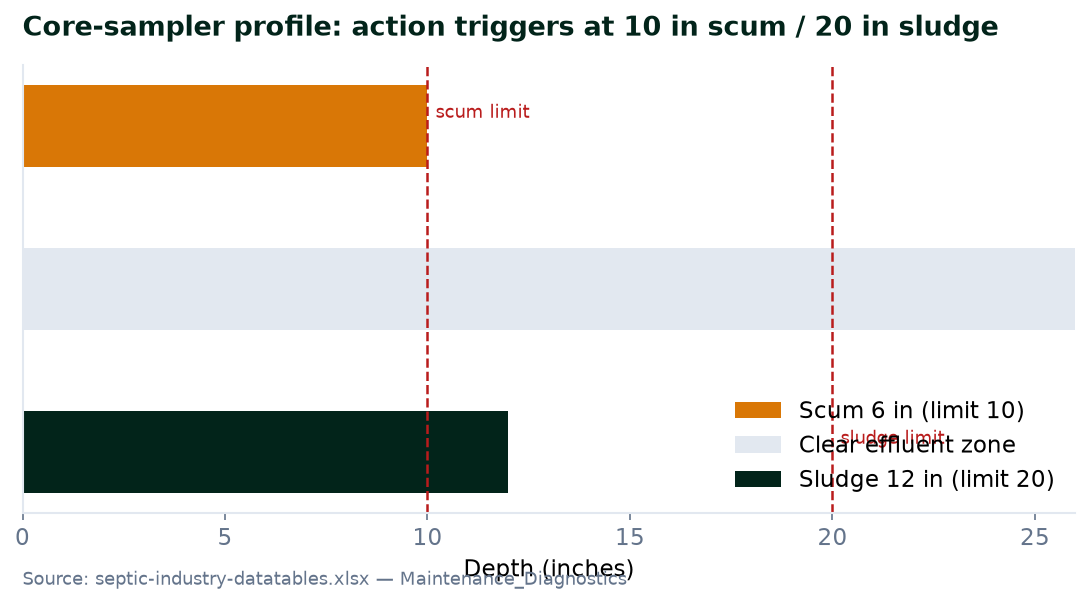
The 10/20 rule: mandatory-action thresholds
Two numbers govern the pumping decision. When the floating scum layer reaches 10 inches, or the bottom sludge layer reaches 20 inches, action is mandatory — the tank is pumped now, not next season. The logic is protective: at those depths the layers are encroaching on the outlet. A thick scum mat can be drawn into the outlet tee and plug the line to the field, while a deep sludge blanket sits close enough to the outlet invert that any surge — a big laundry load, a guest visit — carries solids past the baffle.
Some jurisdictions codify stricter numbers, so confirm the local health district’s rule before you sign the report; Flathead County and Montana DEQ requirements should be checked against current code for the property’s location. One habit separates thorough operators from the rest: after the pump truck leaves, drop the sampler again. A post-pump core showing an inch or two of residual sludge proves the job was done and gives the homeowner a clean baseline for the next cycle.
Lateral camera checks: concrete tees and sulfuric acid gas
The tank’s concrete and ceramic tees are its most failure-prone structures, and the deterioration happens exactly where the lid prevents you from seeing it. Anaerobic digestion releases hydrogen sulfide gas; above the waterline, bacteria on the damp tee convert it to sulfuric acid, which attacks the concrete from the gas space down. The classic result is a tee that looks sound from the port and crumbles under the camera’s light — and a baffle that collapses sends solids straight to the drainfield.
That is why a complete inspection runs a lateral camera through the inlet line from house to tank and, where access allows, from the tank toward the field. You are looking for spalled or delaminated concrete at the tees, a sagging or collapsed baffle, root intrusion, and sags or bellies in the piping. Early detection of a failing tee is a targeted repair; late detection is an excavation. Capture video stills of any defect and attach them to the report — a documented image outweighs any verbal description in a dispute.
Download the deck (PDF)
The proactive field checklist
Preventive care turns a reactive pumping route into a maintenance program. Make these three checks part of every service visit, not just the ones where the homeowner reports a problem:
- Filtration defense: pull, hose down, and reinstall the effluent filter — Zoeller WW1 or WW4 sanitary tee filters are common here, with the WW1 running about $85 to replace — so captured solids never carry over to the drainfield. A clogged filter is a maintenance event; a bypassed one is a failure in progress.
- Biological rejuvenation: on dual drainfields, rotate the diverter valve — Bull Run valves are typical — every 6 to 12 months so the resting trench dries out, aerates, and biologically recovers, extending field life by years.
- Structural protection: keep vehicles and equipment off tanks and laterals. A cracked lid lets in surface water and debris; a snapped PVC transition or compacted soil above the field is silent, expensive damage that surfaces on someone else’s inspection.
Inspector credentials: NAWT and the professional standard
Professional credentialing exists for exactly this kind of work. Inspectors certified through the National Association of Wastewater Technicians (NAWT) train to a standardized protocol, and maintaining that certification requires 8 hours of approved continuing education every 2 years — the mechanism that keeps field practice current as codes evolve. When you hire or recommend an inspector in the Kalispell area, ask to see the credential and confirm it is current; an expired certification is a fair warning that protocol knowledge may be out of date as well.
Buying, selling, or simply worried about a system in Kalispell or Flathead County? We match homeowners with pre-vetted, credentialed local septic inspectors and pumpers — free and with no obligation. Get matched now or call (406) 313-3856.