This walkthrough follows slide two of the technical deck Septic System Failures: Advanced Remediation, Pipe Clearing, and Regulatory Siting (generated with Gemini Notebook) — the “diagnostic tree” that septic professionals actually work through when a homeowner calls about slow drains. It is the same logic our matched Kalispell contractors use, and you can run the first two branches of it yourself before anyone opens a lid.
Start at the Sink: The Flow Test
The tree begins with a single instruction: analyze sink and toilet flow. Stand in the bathroom, run the fixtures, and ask one question — is this one sluggish drain, or is the whole house sluggish at once? A singular slow drain points to a blockage inside your household plumbing: hair, soap scum, or a dropped object in a single fixture line. Branching or system-wide slowness — the tub, the kitchen sink, and the toilet all draining reluctantly — points downstream, toward the septic system itself.
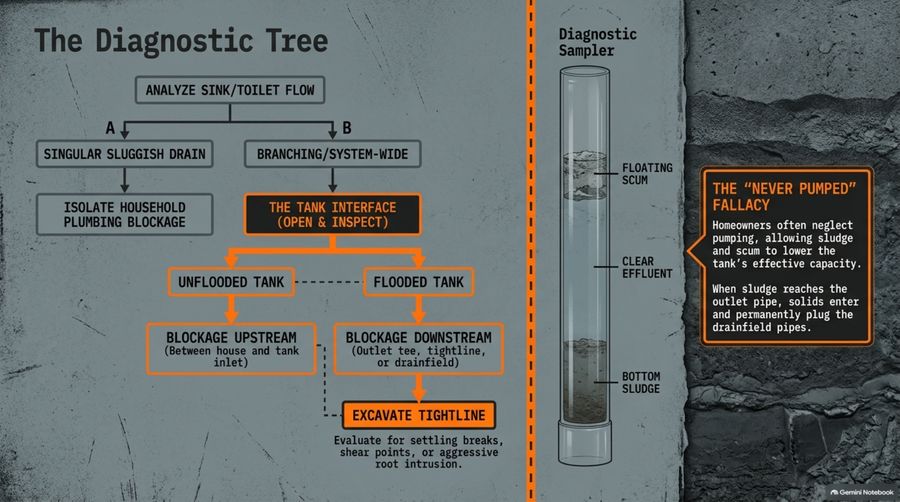
If the problem is a single fixture, the deck says to isolate the household plumbing blockage and clear it there — that is a job for a plumber's snake or a local drain contractor, not a septic company. Far too many Kalispell homeowners pay for a septic visit (or worse, a drainfield replacement) when the culprit was a 20-foot hair clog in a bathroom line. The flow test is free and it kills that whole class of mistakes.
The Tank Interface: Open and Inspect
When the slowness is system-wide, the next branch is the tank interface: open the tank and inspect it. The deck's sampler diagram shows what you are looking for in a healthy tank — a layer of floating scum on top, clear effluent in the middle, and settled sludge on the bottom. Where those layers sit tells you which side of the system is failing:
- An unflooded tank — normal liquid level with a healthy scum and sludge profile — means the blockage is upstream, between the house and the tank inlet. The house line, the inlet baffle, or the pipe itself is plugged.
- A flooded tank — liquid standing at the top of the riser or lid — means the blockage is downstream: the outlet tee, the tightline, or the drainfield is not accepting water.
That one observation splits the entire repair in two. Upstream blockages get cleared mechanically and cost little. Downstream blockages can be anything from a plugged outlet tee to a dead drainfield, and they deserve the full diagnostic treatment before money changes hands.
Reading the layers takes practice, but a few rules cover most homes. A thick mat of floating scum that bridges the tank wall to wall can drag on the outlet tee and let solids ride over into the field when the water level drops — one more reason the deck treats the scum layer as a live measurement, not a detail. And if you cannot safely get the lid off yourself, stop at the tank-interface step: concrete lids weigh hundreds of pounds, and older Kalispell tanks are sometimes buried with no riser at all, under a foot of lawn. An unmarked lid is how curious kids, pets, and adults end up in a tank. When in doubt, a licensed pumper opens the tank for you — it is a standard part of the job, not an inconvenience.
The “Never Pumped” Fallacy
Homeowners often neglect pumping, and the deck calls out exactly what that does: sludge and scum build up and lower the tank's effective capacity. The tank looks fine from the outside; inside, the usable volume has shrunk to a fraction of the rated size. When sludge reaches the outlet pipe, solids flow out of the tank and into the drainfield — and once solids pack the field pipes, they plug them permanently. This is how a skipped pumping job becomes a drainfield replacement you cannot avoid. Regular inspection and pumping is the cheapest insurance in septic ownership.
Upstream vs Downstream: Excavating the Tightline
When the tank is flooded and the outlet side is suspect, the deck's last branch is to excavate the tightline — the pipe running from the tank outlet to the distribution box or field — and evaluate it for settling breaks, shear points, or aggressive root intrusion. A tightline that has settled can separate at a joint; a sheared section quietly dumps effluent into the ground beside the field; tree roots invading the line can strangle flow to nothing. All three look identical from the house: slow drains, full tank, field that never seems to dry. Only excavation tells them apart.
If your system-wide backup keeps coming back, work the tree before you replace anything: flow test, tank inspection, layer check, and — if needed — a look at the tightline. If that process lands on a dead drainfield, our remediation playbook explains the repair ladder from clearing to replacement. For routine maintenance habits that keep you off this tree entirely, see our septic tips guide.
Not comfortable opening lids or reading sludge layers? That is exactly what a licensed pro is for. Call (406) 313-3856 or get matched with vetted Kalispell septic inspectors and pumpers who will run the tree for you — no obligation.
Frequently Asked Questions
Can I tell the difference between a plumbing clog and a septic problem myself?
Usually, yes, with the flow test: if only one fixture is slow, it is almost always household plumbing; if multiple fixtures across the house are slow at the same time, suspect the septic system. A sewage smell or gurgling in several drains pushes the odds further toward septic.
Why does my septic back up right after I had it pumped?
That pattern usually means the tank was never the problem. If the drainfield is failing, pumping the tank removes storage capacity the field was leaning on, and the system backs up faster than before. A flooded-tank inspection after pumping tells you whether the field is accepting water at all.
How often should a Kalispell septic tank be pumped to avoid the never-pumped trap?
Frequency depends on household size and tank volume — a common planning rule of thumb is every 3 to 5 years for an average family home, but the honest answer comes from measuring the sludge layer during an inspection. If the bottom sludge is anywhere near the outlet pipe, pump now, not later.
Slow drains everywhere? Call (406) 313-3856 or match with a local septic pro who will run the full diagnostic tree before recommending any repair.