NAWT Certifications & CEU Compliance: The Professional Standard
Blog · Professional guide · Technicians, contractors & regulators
In the onsite wastewater industry, a credential is not a wall decoration — it is the administrative key that puts your name on approved lists, satisfies municipal ordinances, and tells a homeowner their inspection or installation carries professional accountability. It is also a perishable asset. Certifications expire on fixed cycles, renewals demand documented continuing education, and every registry administers its deadlines differently. Understanding the structure is not busywork; for a technician, contractor, or regulator, it is professional survival.
Why credentials matter
Credentials are the industry’s quality gate. Municipalities write them into law — Rhode Island, for example, requires technicians on its approved inspection lists to hold NEOWTP registry status — and health departments, insurers, and title companies treat current certification as the baseline for accepting an inspection report. Beyond the regulatory mechanics, the continuing-education requirement is what keeps the workforce current as the technology moves: treatment standards, cold-climate certification, and equipment listings evolve, and the CEU hour is the mechanism that drags field practice along with them.
The stakes are regional as well as local. A Kalispell contractor who works the broader northern tier — Washington jobs under WOSSA, Canadian projects under AOWMA, or Massachusetts Title 5 work through NEIWPCC — is effectively juggling several clocks at once, each with its own cycle, hour count, and grace policy. The professional who treats every registry deadline as absolute never has to explain a lapse to a client, a board, or a homeowner whose closing date depends on a signed inspection.
The registries and their cycles
| Registry | Jurisdiction | Cycle | CEU hrs | Grace |
|---|---|---|---|---|
| NAWT | U.S. & Canada | 2 yr | 8 | 1 yr |
| NEOWTP | Rhode Island | 2 yr | 8 | None |
| NEIWPCC | Massachusetts (Title 5) | 2 yr | 12 | None |
| WOSSA | Washington | 2 yr | 8 | 1 yr |
| FOWA | Florida | 1 yr | 6 | None |
| AOWMA | Alberta, Canada | 2 yr | 8 | None |
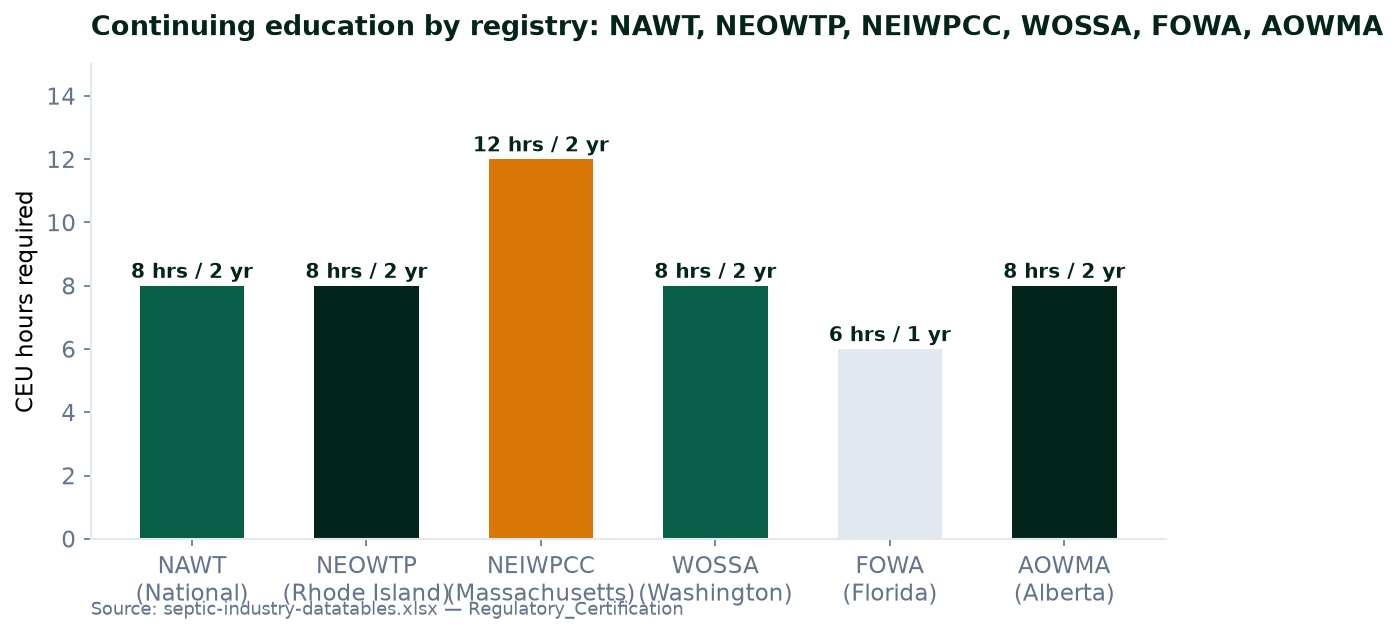
What a lapse means, registry by registry
The consequences of missing a deadline vary by body — and none of them are gentle:
- NAWT (U.S. & Canada): certifications are valid 2 years and require 8 approved CEU hours. Miss the deadline and NAWT grants a 1-year grace period during which your status is marked EXPIRED (Suspended) — and you cannot legally submit inspections until the credits are fulfilled and submitted. Let the grace window close and the certification is forfeited, requiring the course and exam to be retaken.
- NEOWTP (Rhode Island): a 2-year cycle with 8 hours and no grace — a lapse means removal from the municipal approved list, and inspection work stops the day the status drops.
- NEIWPCC (Massachusetts Title 5): the heaviest lift of the group — 12 CEU hours every 2 years — with no grace. Suspension is immediate, and soil evaluator and inspection work cannot proceed until reinstatement.
- WOSSA (Washington): a 2-year cycle with 8 hours and a 1-year grace period similar to NAWT’s.
- FOWA (Florida): the shortest runway in the table — a 1-year cycle with 6 hours and no grace. Annual renewal leaves almost no room for error or procrastination.
- AOWMA (Alberta): a 2-year cycle with 8 hours and no grace period, matching the stricter end of the table.
The common thread is simple: treat the published deadline as a drop-dead date, not a planning target. Regulators do not distinguish between a technician who forgot and one who was busy — the registry status reads the same either way.
Building a CEU tracking habit
Lapses are almost never caused by a shortage of available training; they are caused by a shortage of tracking. The professionals who never slip do the same five things:
- Set the next deadline on renewal day: the moment credits are submitted, put the next cycle’s expiration date in the calendar — before the confirmation email arrives.
- Log every course immediately: record the provider, date, hours awarded, and certificate number in a single spreadsheet or logbook the day you finish the class, not at renewal time.
- Keep certificates for at least three cycles: registries audit, and a missing certificate can turn an approved renewal into a suspension while you chase a provider’s archive.
- Prefer multi-registry-approved courses: one 8-hour course accepted by both NAWT and a state registry can satisfy two clocks at once for the technician holding multiple credentials.
- Submit early and confirm: file the credits 30 days ahead of the deadline and keep the portal confirmation — a lost email is not an accepted excuse for a lapse.
None of this requires elaborate software — a calendar and a spreadsheet beat the most sophisticated system you will forget to update. The goal is a single source of truth you can open at any moment and answer the question every client and board will eventually ask: “Is your credential current?”
Download the deck (PDF)
The cold-climate standards tie-in
Continuing education is not abstract credit-chasing — the content tracks the standards that govern the work. The cold-climate certification CAN/BNQ 3680-600 Class III, for example, demands CBOD5 ≤ 15 mg/L and TSS ≤ 15 mg/L, verified through 12 months of bench testing — roughly half the limits of the NSF/ANSI 40 baseline (CBOD5 ≤ 25 mg/L, TSS ≤ 30 mg/L). For a Kalispell technician working systems buried against a 48-inch frost depth in Flathead County’s dense soils, that difference changes which products qualify, how systems are sited, and what an inspection must verify. A listed unit such as the Ecoflo coco biofilter carries both CAN/BNQ and NSF/ANSI 40 certification; knowing which standard the jurisdiction applies — and why — is exactly the kind of knowledge a current CEU record proves.
That is the deeper argument for compliance: a credential kept current is evidence that practice has kept pace with code, while a lapsed one means working on outdated knowledge precisely in the years the standards moved.
Whether you are a technician mapping your renewal cycles or a homeowner who wants an inspector whose credential is verifiably current, we can help. Kalispell Septic Services matches customers with pre-vetted, credentialed local septic professionals — free and with no obligation. Request your matches now or call (406) 313-3856.