The Silent Septic Killer: Why the "Never Pumped" Fallacy Is Costing You Thousands
By the Kalispell Septic team · September 2026 · For homeowners and buyers across Flathead County
The most expensive sentence in homeownership is also the most common: "We have lived here 18 years and never once pumped the septic." It is said with pride, as if silence proved quality. In reality, it describes a tank that has spent two decades slowly destroying the most costly component on the property — the drainfield. Systems fail quietly, and by the time a never-pumped tank announces itself, the bill routinely runs into five figures.
The Myth: "If It Isn't Backing Up, It Is Working"
A backup is not the first sign of trouble — it is the last. Wastewater keeps draining for years after a system starts failing because the tank simply overflows internally into the drainfield piping. The plumbing works fine while the soil underneath slowly suffocates. Only when the saturated ground finally refuses another drop does water rise into the house.
The myth survives because a septic system has no dashboard: no dipstick at the kitchen sink, no warning light in the laundry room. Water goes down, so homeowners assume all is well. But a septic system is a treatment train, not a storage tank: the tank settles solids and the soil treats the liquid. The tank exists to protect the soil — and when the tank fills, the soil pays.
What Accumulates: Scum Versus Sludge
Open any healthy tank and you will see three layers doing exactly what they should:
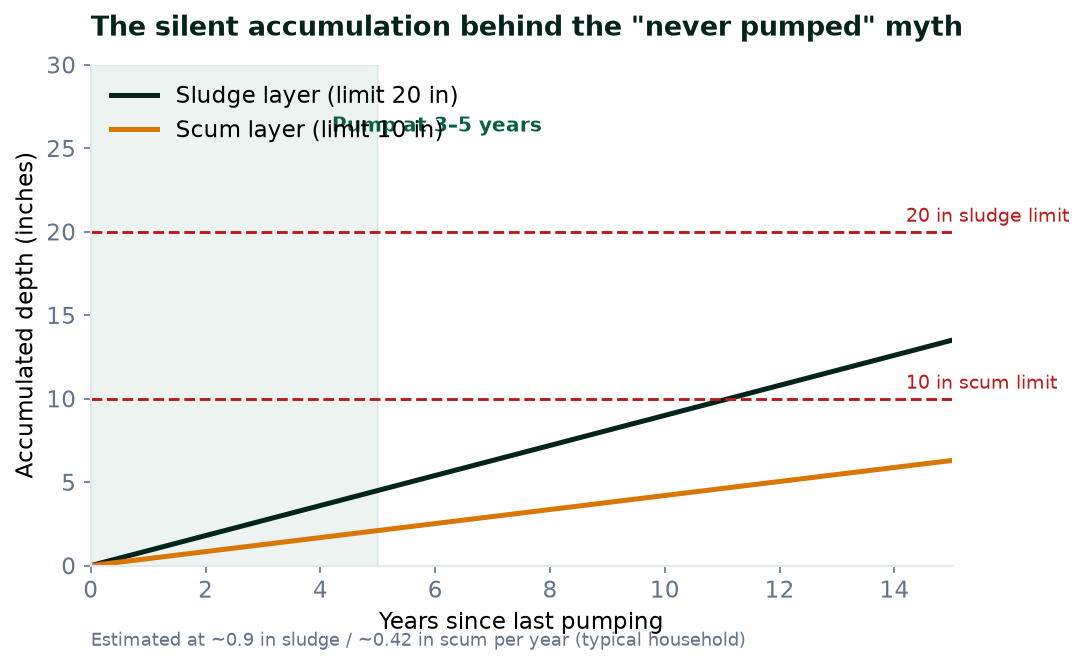
- Scum layer: cooking fats, oils, grease, and soaps are lighter than water, so they float on top — building at a typical rate of about 0.42 inches per year into a crust that thickens with every holiday dinner.
- Clear zone: the middle band of relatively clarified effluent that flows out toward the drainfield; keeping this zone clean is the whole point of maintenance.
- Sludge blanket: heavy solids settle to the floor, where bacteria digest only part of them — the rest compacts at roughly 0.9 inches per year, and what bacteria cannot break down stays forever.
None of it is visible above ground. Inspectors use a Sludge Judge — a clear core sampler lowered to the tank floor that pulls an unmixed, inch-by-inch profile of the contents. Common benchmarks flag a tank for mandatory pumping when the scum layer approaches about 10 inches or the sludge blanket reaches about 20 inches. Those rates are averages — the real pace depends on household size, garbage disposal use, and tank volume, which is why the calendar alone cannot protect a tank.
The Catastrophic Pathway: When Sludge Escapes the Baffle
Here is the sequence nobody sees coming. As the sludge blanket rises, ordinary turbulence — a laundry day, a long shower, a houseful of guests — stirs the bottom of the tank. Particles that should have stayed settled get carried up and over the outlet baffle into the drainfield piping. In the trenches, those solids glue themselves to the soil as a slimy biomat that seals the pores the field needs to breathe. A sealed drainfield cannot be pumped clean; once the pores are clogged, the soil is effectively dead. Eventually effluent ponds, the lawn grows lush, and sewage surfaces or backs up.
There is a second, quieter version of the same story. Trapped sewage gases contain hydrogen sulfide, which converts to sulfuric acid inside the tank — and that acid steadily eats concrete inlet and outlet tees. Lateral cameras catch this deterioration years before a baffle collapses and dumps solids wholesale into the field. Plastic tees and an effluent filter such as the Zoeller WW1 (about $85 list) are cheap defenses against an expensive ending.
The 3-to-5-Year Rule Is Cheap Insurance
Industry guidance is simple: pump and inspect every 3 to 5 years for a typical household. Heavy users — large families, garbage disposals, water softeners, vacation rentals around Whitefish — should stay at the short end of that range. A routine pump-and-inspect costs a few hundred dollars. The alternative is a repair ladder from Repair-As-Is work around $6,500 and biological rejuvenation about $3,500 up to a full aerobic treatment unit or mound system near $25,000. "Never pumped" is not a compliment; it is a deferred expense with interest.
If you do not know when your tank was last pumped — or whether it ever was — book a pump-and-inspect now. Not next spring, and not "when something backs up." By the time something backs up, the drainfield is already compromised.
Buying a Home? No Pumping History Is a Red Flag
Flathead County is full of homes built in the 1980s and 1990s whose tanks have never seen a pumper truck. If you are buying, ask the seller three questions: When was the tank last pumped? Who did it? Can you show the receipt? A seller who cannot produce a single service record is telling you the system has run unmaintained — treat it that way.
Make the septic inspection a condition of the offer, not an afterthought. A good inspector drops a Sludge Judge into the tank, checks the outlet baffle, and walks the drainfield for soggy patches and abnormal grass. Those findings are leverage: a full tank costs a few hundred dollars to fix, while a failing field is a $25,000 problem you do not want to inherit. The greenest strip of lawn often sits directly over a drainfield quietly absorbing solids.
Telemetry: Replacing the Calendar With Data
For pumped systems — basement lifts, mounds, anything with a pump tank — the industry is moving from calendar-based service to demand-driven monitoring. Panels from SJE Rhombus and Orenco, paired with Wi-Fi gateways like the Zoeller Z Control, watch float switches, water levels, and pump amperage in real time, alerting a service provider the moment a float fails or amperage spikes. It is a gift for seasonal cabins around Bigfork and Lakeside, where a pump failure can run for months unnoticed.
Field guide: Download our free Defensive Wastewater Command deck (PDF) for the full maintenance playbook — Sludge Judge thresholds, lateral camera checks, and the field checklist below.
- Effluent filters: hose down the filter (Zoeller WW1 or WW4) at every service visit so solids stay out of the field.
- Diverter valves: rotate valves on dual drainfields every 6 to 12 months so each side rests, dries, and biologically recovers.
- Vehicle traffic: keep trucks and parked cars completely off tanks and laterals — compaction cracks lids and crushes soil pores.
Whether you are servicing a family home in Kalispell, a rental near Whitefish, or a lake cabin you visit only in summer, the principle is the same: a tank pumped on schedule never destroys its own drainfield. Kalispell Septic is an independent matching service — we do not pump tanks or run crews, but we connect Flathead County homeowners with pre-vetted local pumpers, inspectors, and repair pros who do. Call (406) 313-3856 or use our quote form.
Worried about a system you own — or one you are about to buy? Tell us your situation and we will match you with a local inspector or pumper who will give you the straight answer. Get matched with local providers → — no obligation.