Maintenance That Happens in the Field, Not Just in the Tank
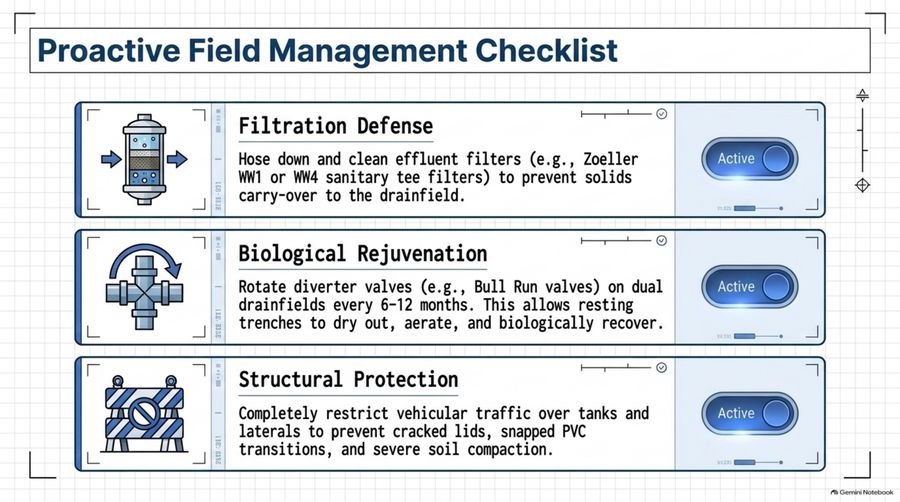
Pumping gets all the attention, but a septic system lives or dies in the drainfield. The soil treatment area is where effluent is finally purified, and it has no moving parts — just soil pores, oxygen, and bacteria doing slow work. Everything a homeowner can do to protect that soil is worth more than any single pump-out. The proactive field checklist covers the three areas where neglect does the most damage: filtration, drainfield rotation, and structural protection.
Filtration Defense: Keep Solids Out of the Drainfield
Most modern tanks route effluent through a filter before it leaves for the drainfield — typically a sanitary tee filter such as the Zoeller WW1 or WW4. The filter catches the fine solids that even a healthy tank lets slip toward the outlet, and it is the cheapest insurance your drainfield can have. But a filter only works if it's clean.
As solids accumulate on the filter, effluent backs up in the tank — and if the filter is never cleaned, the buildup can push material around it and straight into the drainfield. The fix is simple: hose down and clean the effluent filter on a regular schedule, usually at each pump and more often on busy households. A technician can show you how to pull, rinse, and reinstall it safely. Clean filters prevent solids carry-over, and that single habit adds years to a soil treatment area.
Biological Rejuvenation: Rotate Diverter Valves Every 6–12 Months
Properties with two drainfields — common on tighter Flathead lots and systems built with future expansion in mind — use a diverter valve such as a Bull Run valve to send effluent to one field at a time. The second field rests while the first works, and that rest is what keeps both alive.
Resting does real biology: a dormant trench dries out, pulls oxygen back into the soil, and gives the bacterial population time to recover and digest the organic mat that accumulates during use. To capture that benefit, rotate the diverter valve every 6–12 months so each field alternates between service and recovery. Mark the valve's current position and set a reminder — the valve does nothing sitting in one position for five years. On systems with a single field, the same principle argues for spreading laundry and water use across the week instead of loading the field with one laundry day.
Structural Protection: Keep Vehicles Off Tanks and Laterals
The most preventable damage on any septic property happens above ground, and it usually involves something heavy. Completely restrict vehicular traffic over the tank and the lateral lines. That means no parking, no ATVs, no heavy equipment, no snowplow crossing, no RV parked for the summer — anywhere near the buried system.
The damage shows up in three forms. A vehicle crossing the tank can crack the lid, turning a safe access point into a collapse hazard. Weight over the pipe runs can snap the PVC transitions where laterals connect, which leaks untreated effluent into the soil or lets groundwater pour into the system. And even without a visible break, repeated traffic causes severe soil compaction — compacted soil loses the pore space and oxygen the drainfield needs to treat effluent, so a field that looks fine on the surface slowly stops working underneath.
Know where your system is buried. If you don't have the as-built drawing, ask your septic professional to sketch the tank, laterals, and drainfield location on your service record — then make sure everyone who drives, parks, or plows the property knows the boundary.
A Yearly Field Checklist for Flathead Properties
Print this and walk the property once a year — spring, after the ground firms up, is ideal in Kalispell:
- Clean the effluent filter (or schedule it with your pump service).
- Rotate the diverter valve if you have dual drainfields — note the new position.
- Walk the drainfield: look for surfacing water, wet spots, odors, or unusually green grass.
- Check tank lids are intact, sealed, and never buried or paved over.
- Confirm no new parking, storage, or construction has crept over the system area.
- Write the date and observations on your septic service log.
Winter adds one more rule in the Flathead: mark the system area clearly before snow falls, so plow drivers and guests don't discover the tank lid with a truck bumper.
Keep the checklist with your service records and run through it before the heavy-use seasons — before summer guests arrive at the lake place, and again before the holidays. Ten minutes twice a year is a small price for a drainfield that keeps absorbing, and the walk gives you a chance to catch the small problems while they are still just that.
Get a Professional Field Assessment
Filters, diverter valves, and traffic habits are homeowner responsibilities — but a professional eye catches what a walk-around misses. We match Kalispell and Flathead County homeowners with pre-vetted, licensed septic professionals for pumping, filter service, valve checks, and drainfield inspections. Call (406) 313-3856 or fill out our online form to get matched with providers who can audit your whole system, tank to field.
Frequently Asked Questions About Septic Field Maintenance
How often should I clean my septic effluent filter?
Clean the effluent filter at every tank pumping, and more often if your household is large or produces heavy solids — some busy homes rinse it every few months. A clogged filter can push solids past the filter and into the drainfield, so when in doubt, pull it and look.
What does rotating a diverter valve do?
On systems with two drainfields, the diverter valve sends effluent to one field while the other rests. Rotating it every 6–12 months lets the resting trench dry out, aerate, and biologically recover, which keeps both fields healthy and extends the life of the whole system. Mark the valve position so you always know which field is active.
Why can't I drive or park over my septic system?
Vehicle weight can crack tank lids, snap the PVC pipe transitions at the laterals, and compact the soil over the drainfield. Compacted soil loses the oxygen and pore space the field needs to treat effluent, so even damage you can't see gradually kills the system from underneath.