Calendar Guesses vs. Real-Time Alerts
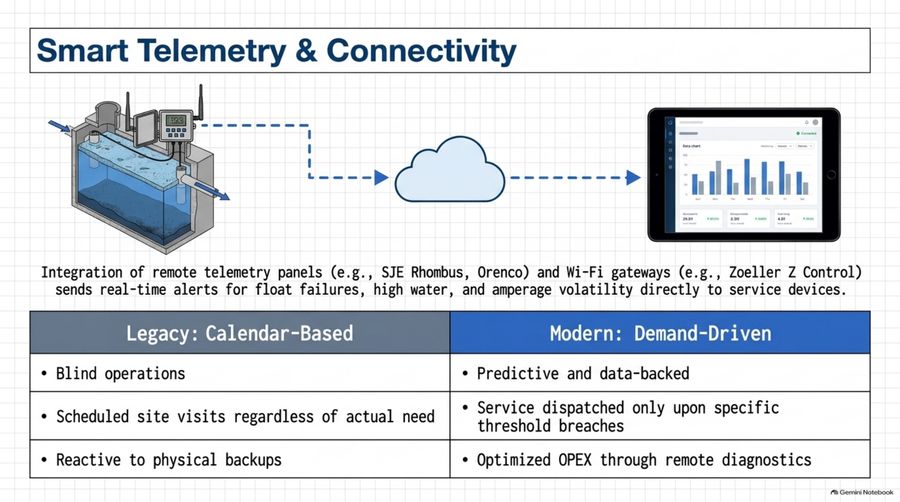
Traditional septic service runs on the calendar. A technician visits on a scheduled date whether the system needs attention or not, and between visits the system runs blind — nobody knows what is happening inside the tank until something backs up. That legacy model is reliable in one sense and wasteful in another: scheduled site visits happen regardless of actual need, and genuine problems are only discovered once they become physical backups.
Smart telemetry changes the equation. Remote panels and Wi-Fi gateways watch the system continuously and send real-time alerts the moment a specific threshold is breached. Service is dispatched when a reading says it's needed — a demand-driven model — instead of on a guess. For Kalispell homeowners, that is the difference between finding out about a problem from a phone notification and finding out from a flooded yard.
What Smart Telemetry Actually Monitors
Telemetry starts with the control panel. Panels from manufacturers such as SJE Rhombus and Orenco run the pumps and alarms on lift stations and pumped systems, and they have long been the brains of advanced installations. What's new is connectivity: Wi-Fi gateways such as the Zoeller Z Control take the panel's readings and push them over the internet to a phone, tablet, or service device.
That connection turns the panel from a local switch into an early-warning instrument. Homeowners and their service provider can see how the system is running at any moment, and the gateway watches for the specific conditions that precede failures — not vague trouble, but measured changes in how the pumps and floats are behaving.
Float Failures, High Water, and Amperage Volatility
Three alert types matter most on a pumped septic system:
- Float failures. Floats tell the pump when to turn on and off. A stuck float means the pump runs continuously, never runs at all, or short-cycles — and each failure mode leads somewhere bad. An alert catches it while the tank still has reserve capacity.
- High-water alarms. The high-water float is the system's last line of defense before a backup. When it triggers, the tank is filling faster than the pump can move it. A real-time alert turns that critical window into a service call instead of an overflow.
- Amperage volatility. Pumps draw a fairly steady electrical current when healthy. Rising, dropping, or erratic amperage signals a struggling motor, a clogged impeller, or a failing pump — often weeks before the pump quits entirely. Catching it early means replacing a pump on a schedule instead of during an emergency.
Because the gateway reports continuously, the service provider can diagnose remotely before rolling a truck — which keeps operating costs down and means the technician arrives with the right parts and a clear picture of the problem. That is the payoff of demand-driven service: optimized maintenance, dispatched only on specific threshold breaches, backed by data instead of blind routine.
Why Flathead Properties Benefit Most
Telemetry earns its keep fastest on the properties this valley is full of: seasonal cabins, vacation rentals, and second homes around Flathead Lake, Whitefish, and Bigfork. A lake house that sits empty from October to May is exactly the system nobody is watching — until the spring opener reveals a pump that failed mid-winter. With a Wi-Fi gateway, a float failure in January is a notification in February, and a service visit can happen long before you arrive for the season.
Remote diagnostics also cut down on unnecessary visits. When a reading looks questionable, the provider can pull the panel's history and check the current status from the office before deciding whether a truck needs to roll — that is what optimized operating costs through remote diagnostics means in practice. Homeowners see fewer drive-out charges, and when a technician does come, they arrive with the right parts and a clear picture of the fault instead of starting from scratch at the tank.
Homes with pumps, lift stations, or low-pressure drainfields — common on tight Flathead lots and lakeshore slopes — get the most value, because those systems depend on mechanical parts that can fail without any change visible in the house. Even gravity systems benefit from high-water and alarm monitoring at the tank.
Telemetry Works With, Not Instead of, Pumping
Smart monitoring is a layer of defense, not a replacement for maintenance. The electronics tell you when pumps fail and when levels climb; they don't remove the sludge that builds in the tank. Keep the 3–5 year pumping rhythm, keep the effluent filter clean, and let telemetry watch the mechanical side between visits. The two together are what “predictive and data-backed” care actually looks like.
Getting a Smart System Installed in Kalispell
Retrofitting telemetry usually means having a licensed professional upgrade the control panel or add a gateway to an existing alarm system — a straightforward job on most pumped installations. We match Kalispell and Flathead County homeowners with pre-vetted, licensed septic professionals who install and service SJE Rhombus, Orenco, and Zoeller equipment. Call (406) 313-3856 or fill out our online form to get matched with providers near you.
Frequently Asked Questions About Smart Septic Telemetry
What does a smart septic telemetry system do?
It connects your septic control panel — from manufacturers like SJE Rhombus or Orenco — to a Wi-Fi gateway such as the Zoeller Z Control, then sends real-time alerts when monitored conditions change. That includes float failures, high-water events, and amperage volatility that signal a failing pump, so problems are caught while they are still service calls.
Can I get alerts about my septic system on my phone?
Yes. With a connected panel and gateway, alerts are pushed to a phone app or to your service provider's monitoring system, wherever you are. That is the main advantage over a basic alarm that only beeps at the tank — nobody hears a beep at an empty lake cabin, but a notification reaches you anywhere.
Is smart septic monitoring worth it for a vacation home?
For seasonal and rental properties it often pays for itself the first winter. A pump or float failure that goes unnoticed for months can flood the tank area, damage the control panel, or push solids toward the drainfield. Remote alerts turn that into a timely service visit instead of an expensive discovery in the spring.