The Weight of Wastewater: Why Polymer Is Replacing Concrete in Modern Septic Installations
By the Kalispell Septic team · September 2026 · For homeowners and builders around Kalispell, MT
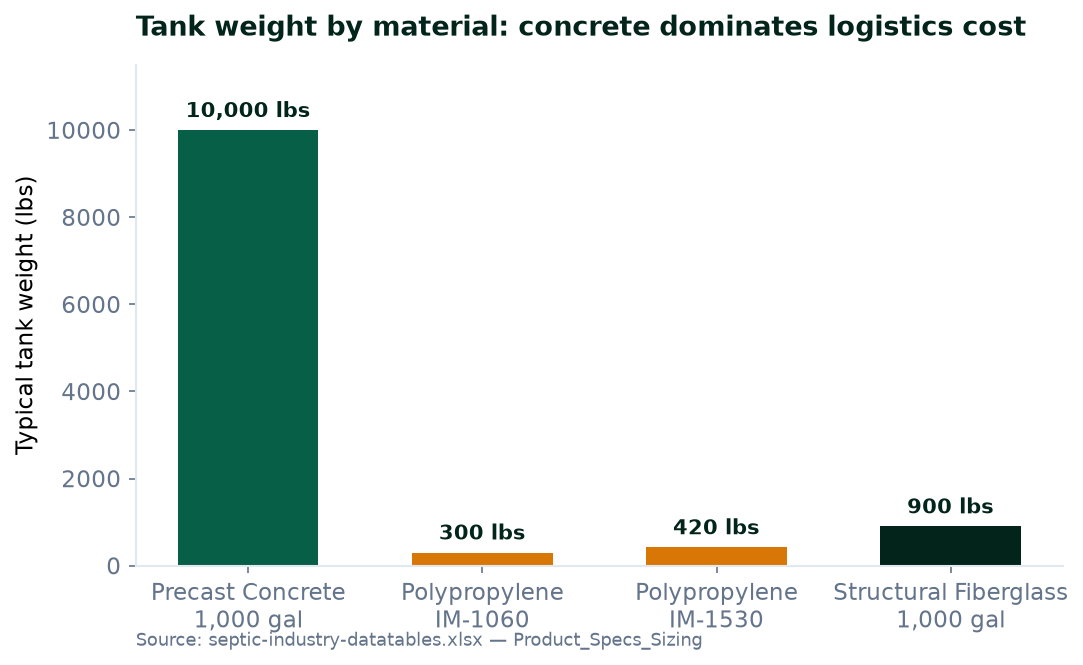
Ask a Kalispell contractor what surprises homeowners most about a septic install and the answer is rarely the biology — it is the weight. A precast concrete tank can exceed 10,000 pounds, demanding a crane and wide site access. Modern polypropylene and fiberglass tanks weigh a fraction of that, install in hours instead of a full day, and arrive watertight from the factory. This guide covers why lightweight polymer systems are becoming the default on Flathead County lots, what the ribbed engineering does, and how the components compare at list price.
Why a 10,000-Pound Tank Is a Logistics Problem on Montana Lots
Concrete earned its run for good reasons: it is inexpensive, massive, and inert, and precasters such as Shoaf have poured dependable tanks for decades. But mass is the problem on many Montana sites — a typical precast tank weighs more than 10,000 pounds, as much as a loaded dump truck, and setting one takes a crane on site.
Now apply that to a real Flathead Valley site: a narrow lakefront lot in Somers or Bigfork, a parcel off a gravel road near Kila that turns to gumbo every spring, a winter start with ground frozen to the 48-inch frost line. Cranes need stable pads and wide turning room. Trees get removed, driveways get rutted, and on steep ground an operator may simply refuse the reach — forcing a redesign or a costlier alternative.
Polymer flips that script. A polypropylene tank weighs only a few hundred pounds and can be rolled into the hole by the crew — no crane, no access road, no tree removal. Less equipment traffic keeps the native soil around the tank and trenches intact, and intact soil is what your drainfield depends on for decades.
Ribs and Engineering: Polymer Is Not Just Plastic
The first objection builders raise is durability: will plastic survive decades of Montana winters? The engineering answer lives in the ribs. Polymer tanks are molded as a single shell with built-in reinforcing ribs engineered to withstand dynamic soil compaction and resist collapse during empty pumping cycles — when the pumper vacuums the tank dry and soil pressure peaks on an unbraced shell.
Concrete meets that load with sheer mass, but mass does not flex. Hairline cracks from settling or frost heave can open pathways a molded polymer shell simply does not have — there is no seam to open. Recycled-polypropylene models like the CM-1060 deliver the same ribbed design with a lighter environmental footprint.
Watertight Means Watertight: The Cold-Joint Problem
Here is the quiet weakness of precast concrete: most tanks arrive in sections and are sealed on site, and every joint — plus every pour seam in a cast wall — is a potential cold joint that can wick water over time. Gaskets age, and the Flathead Valley's high spring water table finds every weakness.
Why it matters: groundwater infiltration adds clean water to a system built to treat wastewater, diluting treatment and flushing solids toward the drainfield. And a leaky tank works both ways — partially treated effluent can escape toward wells and lakes. Polymer and premium fiberglass tanks are molded as one continuous, 100 percent watertight vessel, eliminating groundwater infiltration entirely.
For buyers who want the top of the watertight market, fiberglass — such as Orenco's 1,000-gallon tank at roughly $1,950 list — is the premium choice. For most homes, a ribbed polypropylene tank delivers the same factory-sealed guarantee for less.
Field guide: Our free Advanced Wastewater Engineering deck (PDF) covers polymer versus concrete construction, rib design, dosing math, and treatment standards.
Gravelless Chambers Keep the Working Soil Intact
Whichever tank you choose, the drainfield does the real treatment — and Montana's best treatment medium is the native ground under your lawn. Traditional gravel trenches need dump trucks full of stone, and every pass compacts the very soil meant to absorb effluent. Gravelless chambers such as the Quick4 Plus (about $165 list per chamber) and synthetic aggregate systems like EZflow (about $145 list) eliminate gravel delivery entirely, exposing the native soil's bottom and sidewalls directly to effluent. That preserves the macro-pores that keep soil aerobic and extends the system's life.
It is the same logic as the lightweight tank: the less the ground is crushed during construction, the longer it treats water afterward.
Side-by-Side: Tanks and Components at List Price
The table shows list prices for the components themselves. Your installed quote adds freight, excavation, and site work — exactly where polymer's advantage shows — and labor figures appear where manufacturer data publishes a typical value.
| Manufacturer | Product | Model | Material | List Cost | Install Labor |
|---|---|---|---|---|---|
| Infiltrator | Septic tank | IM-1060 (1,094 gal) | Polypropylene | $1,150 | ~4 hrs |
| Infiltrator | Septic tank | IM-1530 (1,537 gal) | Polypropylene | $1,550 | Varies by site |
| Orenco | Septic tank | 1,000 gal | Fiberglass | $1,950 | Varies by site |
| Shoaf | Septic tank | 1,000 gal | Precast concrete | $1,350 | ~8 hrs |
| Zoeller | Effluent pump | N57 (1/3 HP) | — | $220 | Varies by site |
| Infiltrator | Gravelless chamber | Quick4 Plus | Polypropylene | $165 | Minimal per unit |
Read that table twice. The concrete tank is the cheapest box and the most expensive install: eight hours of labor plus crane logistics against roughly four hours for the IM-1060. And $1,550 buys the IM-1530's 1,537 gallons of factory-sealed reserve volume — capacity that matters when a big family hosts the holidays or a wet spring pushes the water table up. A 1,000-to-1,500-gallon tank is typical for a three- to four-bedroom home.
The 20-Year Perspective
Septic decisions are made on a 20-year horizon, and on that horizon the tank's list price is the smallest number in the equation. Excavation and labor dominate the first invoice; the drainfield dominates the second. If a tank cracks, leaks, or lets solids through, the drainfield pays — and drainfield failures are where the real money lives, with fixes from Repair-As-Is work near $6,500 and biological rejuvenation around $3,500 up to a full aerobic treatment unit or mound system close to $25,000.
A watertight polymer tank defends that investment twice over: it never adds clean groundwater to the treatment train, and its smooth interior sheds solids so the tank fills more slowly and pumps out cleaner. Add ribs engineered to survive empty-pumping cycles and you have a vessel built to outlast the mortgage on the house above it.
Montana reminder: whatever material you choose, a Flathead County tank sits below 48 inches of frost — insist on access risers to grade and lids rated for the loads above them, and never park vehicles over the tank.
Not sure which tank belongs on your lot? Kalispell Septic is an independent matching service — we do not sell tanks or run install crews. Tell us about your project and we will connect you with up to three pre-vetted local installers who will spec polymer, concrete, or fiberglass honestly for your site. Call (406) 313-3856 or use our quote form — free, no obligation.
Want help finding the right septic provider? Tell us what you are building and we will match you with Kalispell-area installers who know the soil, the frost, and the permit process. Get matched with local providers → — no obligation.