Drawing the Line: Siting Rules and Horizontal Separation Setbacks on Your Property
By the Kalispell Septic team · September 2026 · For rural buyers and property owners in the Flathead Valley
A septic permit is approved in inches and feet. Before any soil is moved, a sanitarian draws invisible lines across your property: how far the drainfield must sit from your well, from surface water, from storm sewers, from property lines, and from buildings. These horizontal separation setbacks exist for one overriding reason — protecting drinking water — and they quietly decide which parcels can support a conventional septic system and which cannot.
Why Setbacks Exist: Protecting the Well You Cannot See
A drainfield does not just dispose of wastewater — it treats it. Effluent leaving the trenches still contains pathogens and nitrogen, and the unsaturated soil between the field and the water table is the treatment medium: it filters organisms, and time and distance allow many to die off. Setbacks buy that time. A well draws from the same ground your drainfield drains into, so regulators demand enough horizontal separation for the soil to do its work.
Nitrogen is the reason the distances are as large as they are. Nitrates do not die off in soil the way bacteria do — they move with groundwater, and dilution is the only real treatment. That is why the line between a septic system and a well is measured in dozens of feet, not a few.
The Numbers by State: A Comparison in Feet
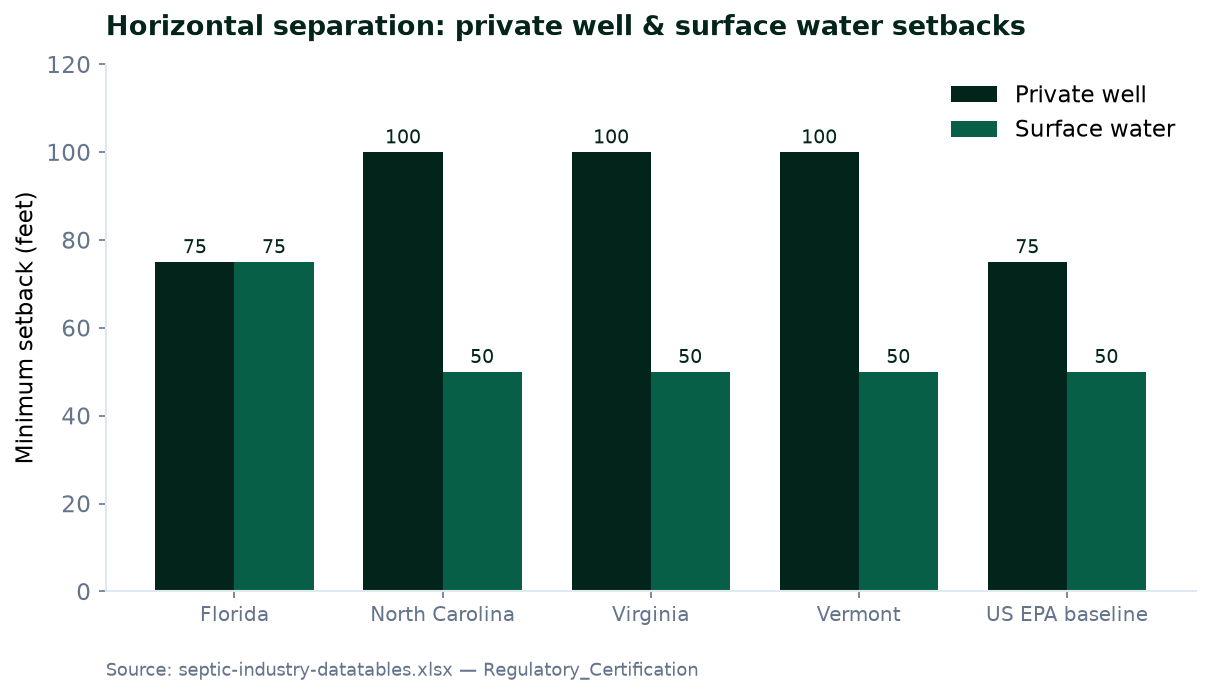
Every state writes its own minimums. The table shows horizontal separation distances, in feet, between septic components and the features regulators care about most — private wells, surface water, storm sewer pipes, and property lines — for a sampling of states, with the EPA baseline for reference:
| State | Private Well | Surface Water | Storm Sewer | Property Line |
|---|---|---|---|---|
| Florida | 75 | 75 | 10 | 5 |
| North Carolina | 100 | 50 | 15 | 10 |
| Virginia | 100 | 50 | 10 | 5 |
| Vermont | 100 | 50 | 10 | 10 |
| EPA baseline | 75 | 50 | 10 | 5 |
Read the pattern: states that lean on groundwater — like Florida, with its shallow aquifers — push surface water protection out to 75 feet, while most states hold the well line at 100 feet and the storm sewer line at 10 to 15. Property lines get 5 to 10 feet, not because a neighbor's lawn is fragile, but because their well and basement deserve the same protection yours does. These are minimums: local health departments routinely require more where soils are poor, water tables are high, or wells are shallow.
Field guide: Our free Advanced Wastewater Engineering deck (PDF) includes a setback map and explains how separation distances get applied on real lots.
The 10-Foot Building Rule
Beyond wells and water, nearly every code holds septic components at least 10 feet from building foundations. A saturated drainfield hugging a foundation pushes moisture against footings and basement walls — a recipe for seepage and frost heave in a climate where the ground freezes to 48 inches. And the building side protects the septic system too: future additions, patios, or shops built over a field will compact the soil and crush the trenches that treat your wastewater.
The rule is also why smart buyers map the house site and the drainfield together before they commit. A home placed to capture mountain views may sit exactly where the septic field needs to go.
Why Setbacks Delay Permits
Most permit failures are not soil failures — they are geometry failures. The classic sequence: a buyer finds the perfect parcel, closes on it, then discovers the well sits 60 feet from the only buildable spot, the county road ditch counts as surface water, or the neighbor's well and the property line leave no room for both a field and its reserve area. When the numbers do not fit, the sanitarian does not bend the rules — the design changes, usually toward a mound or aerobic system that can cost close to $25,000, or the permit is denied outright.
What happens at the health department: the site gets a soil evaluation with deep test pits, the seasonal high water table gets measured, and every setback is checked against the proposed layout. Coarse, gravelly ground near Flathead Lake transmits water quickly, which argues for more separation, not less. And with the ground frozen to 48 inches for months, soil testing is a spring-through-fall activity — a winter permit application can sit until the thaw.
The Flathead County Angle
Flathead County parcels are a study in contrasts: glacial till and gravelly outwash in the valley, tight lakefront lots around Bigfork, Somers, and Lakeside, and seasonal water tables that rise every spring with snowmelt. Statewide rules set the floor, but the Flathead City-County Health Department applies them to your specific ground — which is why an installer who has pulled permits in Columbia Falls knows things a contractor from out of the valley does not.
Run a Pre-Check Before You Commit
Before you make an offer on rural property, run the numbers yourself. Start with our free septic pre-check and planning tools at /tools/, then confirm on the ground:
- Wells: locate every well on the property — and your neighbors' wells within a generous radius of the proposed field.
- Water: note ditches, ponds, streams, wetlands, and springs; a county road ditch counts as surface water.
- Easements: check the title for storm sewer lines, utility easements, and irrigation rights that can block a field.
- Field size: budget about 120 gallons per bedroom per day of design flow, then confirm the soil can absorb it in the space left after setbacks.
Buyer Due Diligence: Know the Lines Before You Sign
A septic system that cannot be sited is not a minor defect — it is a deal-breaker hiding in the fine print. Before closing, pull the county's septic permit records for the parcel, confirm there is an approved system or a viable site for one, and walk the property with a tape measure and the setback table in hand. If the seller's well sits suspiciously close to the drainfield area, get a professional site evaluation as a condition of the offer. A few hundred dollars of diligence can prevent a five-figure mistake.
Kalispell Septic is an independent matching service — we are not a provider, and we do not sell parcels or permits. We connect Flathead Valley buyers and property owners with pre-vetted local engineers, soil testers, and septic contractors who know exactly what the county will require on your ground. Call (406) 313-3856 or request quotes through our form — free, no obligation.
Buying land or building in the Flathead? Tell us about the parcel — lot size, well location, water features — and we will match you with local professionals who can tell you whether the septic will fit before you commit. Get matched with local providers → — no obligation.