Precision Wastewater Hydraulics: Sizing Timed-Dosing Systems and Managing Freeboard Volume
Blog · Engineering guide · Civil engineers, designers & inspectors
Recirculating media filters (RMFs) produce some of the highest-quality effluent available in onsite treatment — but only when their hydraulics are engineered, not assumed. The media bed can only polish what the dosing system meters onto it, and the tank needs surge capacity when inflow outruns disposal. That reserve is freeboard, and sizing it is a calculation, not a guess. This guide walks the governing equation, works a real example, and explains why timed dosing has displaced the on-demand siphon.
The freeboard equation
Every RMF hydraulic design begins with one relationship:
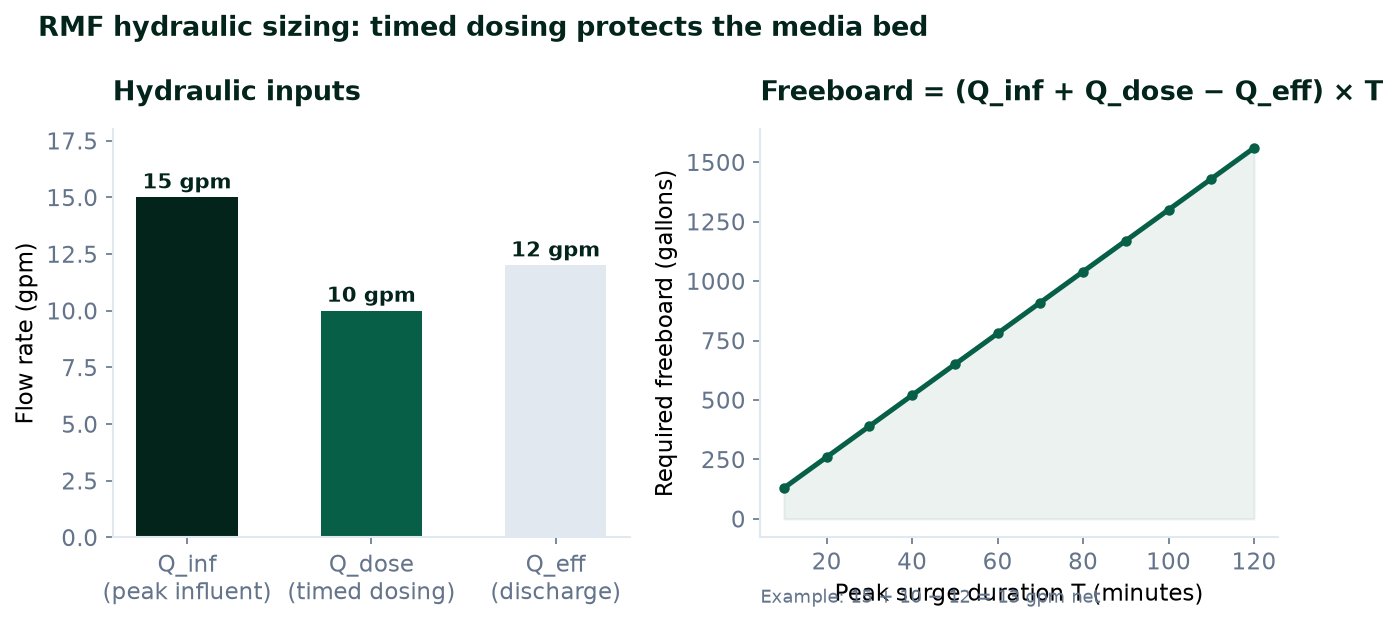
Net accumulation rate (gpm) × duration of the peak window (minutes) = required freeboard storage (gallons).
- Qinf — peak influent rate (gpm): the highest sustained inflow the tank must accept, based on the US EPA convention of 120 gallons per day per bedroom — a four-bedroom home carries a 480 gpd design flow before peaking factors are applied.
- Qdose — dosing flow rate (gpm): what the pump delivers at operating head, read from the manufacturer’s curve, not the nameplate. Cast-iron effluent pumps such as the Zoeller N57, N137, and N140 are common choices here.
- Qeff — effluent discharge rate (gpm): the rate at which treated effluent leaves the tank, relieving accumulation during the peak window.
- T — duration of peak flow during recirculation suspension (minutes): the most misread variable in the formula — it deserves its own paragraph.
T is not total pump runtime, and it is not the daily cycle time. It is the duration of the peak-flow event during which normal recirculation is suspended — the minutes the system runs effectively single-pass and the tank must bank the difference between what arrives and what can leave. What matters is the longest sustained surge — a holiday gathering, a full house — while recirculation pauses and inflow keeps arriving. In cold climates the window can lengthen when equalization protects media from frigid return flows, so size T for the worst case.
Worked example: a four-bedroom Kalispell home
Take a four-bedroom home in Flathead County with a 480 gpd design flow. During a sustained peak — guests, laundry, a full house — inflow reaches 15 gpm. The timed-dosing pump discharges at 10 gpm while recirculation is suspended, and treated effluent leaves the tank at 12 gpm. Net accumulation during the window is:
The design consequence is concrete: the tank must hold 780 gallons of usable storage between the normal operating level and the high-water alarm set point. If it cannot, the system surcharges toward the inlet before the window closes. For the inspector, verifying alarm elevations against the stamped freeboard number is the field check on the engineer’s arithmetic. Run your own figures with our free RMF freeboard calculator on the tools page.
Timed dosing vs. on-demand siphons
The gravity siphon is elegant — no power, no moving parts — but as a media-filter dose mechanism it is a liability: it fires when it fills, producing high-frequency, highly volatile surges that track the household’s worst moments and hammer the filter with slugs of effluent during peak use.
A timed-dosing system governed by a programmable logic controller (PLC) panel inverts that logic: doses arrive on steady, programmable intervals set in the design office, the tank absorbs the peaks, and the media sees metered, uniform loading with defined rest periods — the conditions under which its treatment claims were tested.
The media washout mechanism
Precision matters here. Each dose drives a wetting front through the filter; at high frequency the media never fully drains between cycles. Saturated zones form, channels develop along the path of least resistance, and the aerobic biofilm doing the treatment is sloughed off in sheets and carried out of the bed — media washout. Symptoms follow in sequence: rising total suspended solids in the effluent sample, ponding on the media surface, odor, and a biomat migrating into the underdrains.
Cold climate compounds the failure. In Flathead County, where systems are buried against a 48-inch frost depth, an overwetted filter that stays saturated into freeze-up can ice from within and lose capacity for the season. Low-dose, high-frequency operation protects only when dose volume and interval are engineered around the media’s drainage rate — what a PLC enforces and a siphon cannot.
Telemetry and PLC control
Modern dosing panels pair PLC logic with remote telemetry — Wi-Fi gateways such as the Zoeller Z Control and supervisory panels from Orenco and SJE Rhombus — pushing real-time alerts for float failure, high water, and pump amperage volatility to service devices. Maintenance shifts from calendar-based to demand-driven, with dispatch on threshold breaches rather than after a backup. The event log is equally valuable: dose counts, run times, and alarm history are field evidence the hydraulics behave as engineered — or the first clue a sticking float is about to test the freeboard.
Download the deck (PDF)
The standards matrix: what the treatment claims mean
Freeboard keeps the hydraulics honest, but the permit ultimately rests on treatment performance. Three listings dominate engineered designs, and their limits are not interchangeable:
| Standard | Effluent limits | What it means in practice |
|---|---|---|
| NSF/ANSI 40 | CBOD5 ≤ 25 mg/L; TSS ≤ 30 mg/L | Baseline secondary-treatment listing most regulators check first |
| NSF/ANSI 245 | ≥ 50% total nitrogen reduction | Nitrogen-removal credit in nutrient-sensitive basins |
| CAN/BNQ 3680-600 Class III | CBOD5 ≤ 15 mg/L; TSS ≤ 15 mg/L | Cold-climate certification, proven via 12-month bench testing |
The gaps matter: CAN/BNQ 3680-600 Class III demands roughly half the CBOD5 and TSS of the NSF/ANSI 40 baseline — a real difference when a jurisdiction applies cold-climate criteria to a Kalispell installation. Specifying a product that carries the listing turns a performance claim into a certified number: the Ecoflo coco biofilter (about $4,200) is listed to CAN/BNQ 3680-600 and NSF/ANSI 40; the Norweco Singulair (about $3,800) carries an NSF/ANSI 40 Class I listing. Gravelless chambers such as the Quick4 Plus preserve soil macro-pores by eliminating the heavy gravel deliveries that compact the soil the field depends on.
Check your numbers before the permit reviewer does
Freeboard sizing is a ten-minute calculation that prevents a decade of alarm events. Enter your own Qinf, Qdose, Qeff, and T in our free RMF freeboard calculator and compare the result against the tank’s usable volume above the high-water alarm.
Designing, building, or inspecting an engineered system in Kalispell or around Flathead County? We match you with pre-vetted local septic engineers and contractors — free and with no obligation. Request your matches now or call (406) 313-3856.